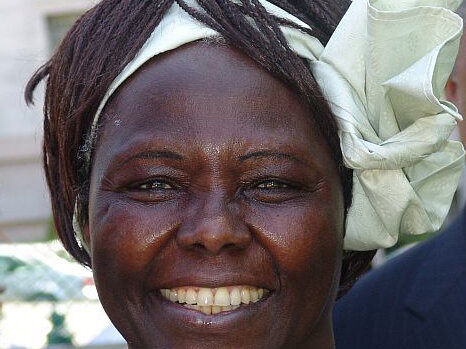
On 8 October 2004 Wangari Maathai learned she had won the Nobel Peace Prize while she was in Nyeri, in her home region of Kenya. Before speaking to reporters she planted a tree, a Nandi flame. She was the first African woman to receive the prize, awarded "for her contribution to sustainable development, democracy and peace".
From Kenya to Kansas
Wangari Muta was born on 1 April 1940 in Ihithe, a village in Kenya's central highlands, then a British colony. She went to school, which was rare for a girl of her generation. In 1960 she was one of the Kenyan students sent to the United States on a scholarship programme backed by the Kennedy family. She studied biology in Kansas and then at the University of Pittsburgh.
Back in Nairobi she completed a doctorate in veterinary anatomy in 1971, becoming the first woman in East and Central Africa to earn one. She went on to head the veterinary anatomy department at the University of Nairobi, and campaigned for women lecturers to get the same benefits as their male colleagues.
The green belt
In the mid-1970s rural women told her that streams were drying up, that they had to walk further and further for firewood, and that the soil was getting poorer. Her answer was simple: plant trees. In 1977, with the National Council of Women of Kenya, she started what became the Green Belt Movement. Women grew seedlings in nurseries and were paid a small sum for each tree that survived.
The movement says more than 51 million trees have been planted in Kenya since. The meetings were also a place to talk about rights, governance, and how decisions taken in Nairobi affected the villages.
Standing up to power
This work set her against Daniel arap Moi's government. In 1989 she opposed plans for a 60-storey tower for the ruling party in Uhuru Park, in central Nairobi. MPs in parliament called her a madwoman; the foreign investors eventually pulled out and the park was saved.
In 1992 she joined mothers of political prisoners on hunger strike in Uhuru Park. Police broke up the protest and she was beaten unconscious. She was arrested several times during those years, and injured in 1999 while defending Karura Forest from property developers.
MP and minister
In 2002, after Moi left office, she was elected MP for Tetu with 98% of the vote and appointed assistant minister for the environment. She was in that post when she won the Nobel. In her Oslo lecture she pointed out that many wars are fought over dwindling resources.
She told her life story in Unbowed (2006). She also liked to tell the fable of the hummingbird that carries water to a forest fire one drop at a time, and tells the other animals: "I am doing the best I can." Wangari Maathai died of cancer in Nairobi on 25 September 2011, aged 71.
© Photo: Kingkongphoto & www.celebrity-photos.com - CC BY-SA 2.0 (cropped)