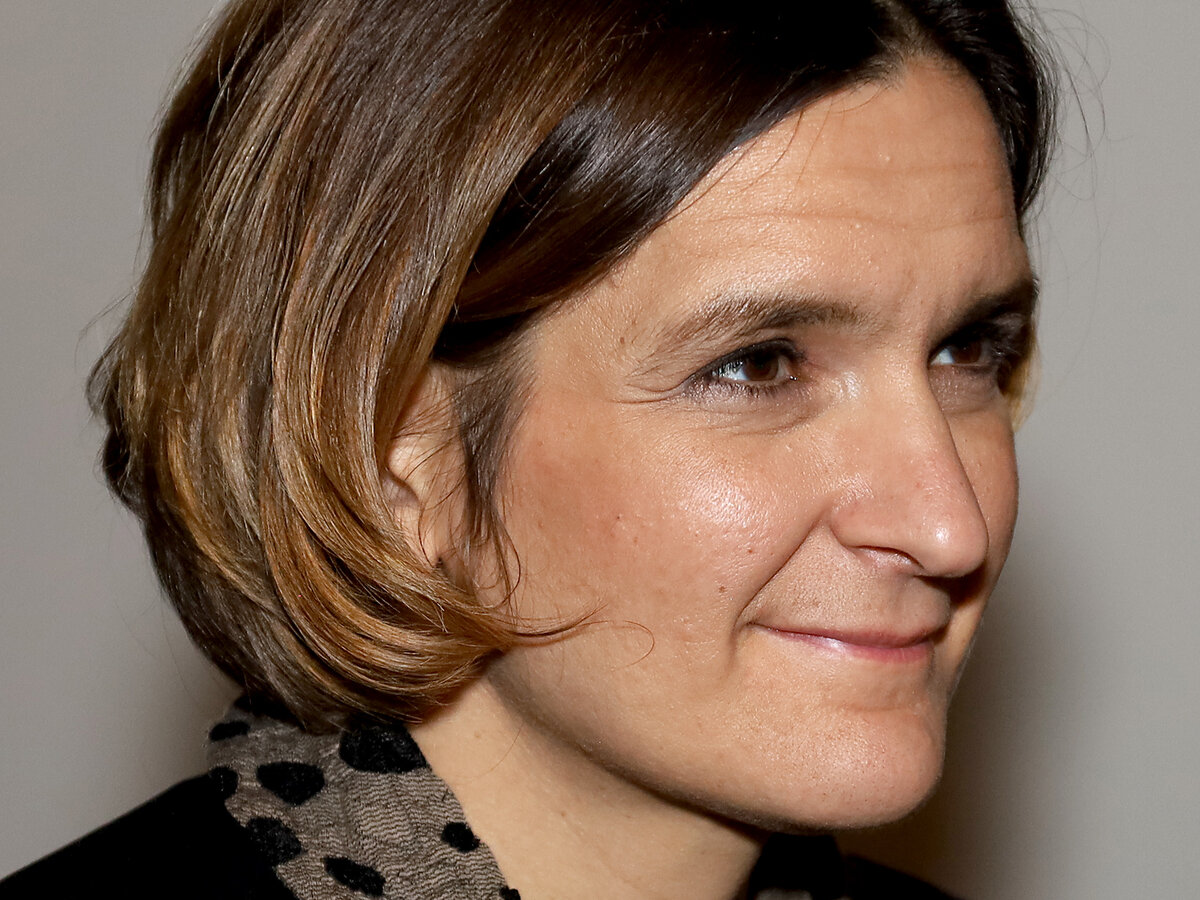
On 14 October 2019 Esther Duflo was awarded the Sveriges Riksbank Prize in Economic Sciences in Memory of Alfred Nobel, with Abhijit Banerjee and Michael Kremer, "for their experimental approach to alleviating global poverty". At 46 she was the youngest person to receive it, and only the second woman after Elinor Ostrom.
A paediatrician mother and a year in Moscow
Esther Duflo was born in Paris on 25 October 1972. Her mother is a paediatrician who regularly went on humanitarian missions; her father taught mathematics. She studied history and then economics at the École normale supérieure. A year in Moscow in the early 1990s, as a research assistant to economists advising the Russian government, convinced her that economics could change people's lives in concrete ways, and that it could also get things badly wrong.
She moved to MIT and completed her PhD in 1999, supervised by Abhijit Banerjee and Joshua Angrist. MIT hired her straight away.
Clinical trials for public policy
Her method borrows from medicine. To find out whether a policy works, you offer it at random to some villages or schools and not to others, then compare. In 2003 she founded the J-PAL lab with Abhijit Banerjee and Sendhil Mullainathan. It now coordinates hundreds of such studies around the world.
One often-cited example comes from Rajasthan, in India. In villages where very few children were fully immunised, the team ran regular immunisation camps and, in some of them, gave families a kilo of lentils at each visit. Full immunisation rose from about 6% with no intervention to 18% with the camps, and to 39% with the lentils. The small gift cost less than the doses wasted when nurses waited for children who never came.
These results, and others on schooling, mosquito nets and microcredit, are told in Poor Economics (2011), written with Abhijit Banerjee. The book treats the choices of poor families as reasonable given their constraints, not as mistakes to be fixed.
The critics
The approach has its detractors. Some economists say these experiments only answer small questions, or treat people as test subjects. Duflo's reply is that testing stops governments from scaling up useless programmes, and that big questions are partly answered by small ones.
She received the John Bates Clark Medal in 2010. At the Collège de France in Paris she was the first holder of the "Knowledge against poverty" chair in 2008, and later took up a permanent chair in poverty and public policy. With Abhijit Banerjee, her husband, she also wrote Good Economics for Hard Times (2019), on migration, trade and inequality in rich countries.
From Boston to Zurich
In October 2025 the University of Zurich announced that the couple would join it in July 2026, to lead a new centre for development, education and public policy funded by the Lemann Foundation. They keep part-time posts at MIT and their roles at J-PAL, and Duflo is returning to teach at the Collège de France.
© Photo: US Embassy Sweden - CC BY 2.0 (cropped)