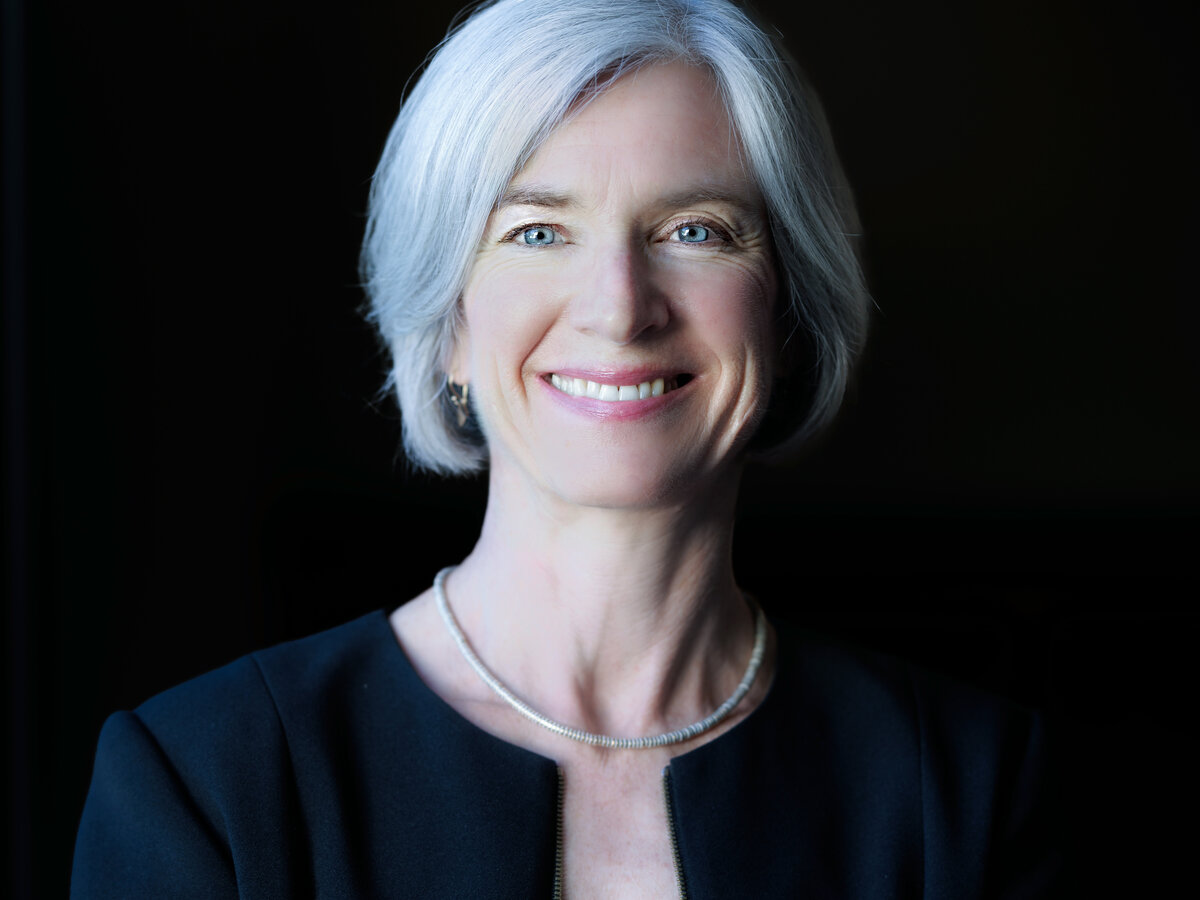
On 7 October 2020 Jennifer Doudna was asleep in Berkeley when a reporter woke her up to ask for a comment. She did not yet know that she had won the Nobel Prize in Chemistry, with Emmanuelle Charpentier, for the genome-editing tool CRISPR-Cas9.
Growing up in Hilo
Jennifer Doudna was born in Washington DC on 19 February 1964. When she was seven, her family moved to Hilo, on Hawaii's Big Island, where her father taught American literature. She felt like an outsider, tall and blonde at a school where most children had Polynesian or Asian roots, and spent her time outdoors looking at plants and insects.
At around 12 she found a book her father had left on her bed: The Double Helix, James Watson's account of discovering the structure of DNA. What she took from it was that you could try to work out how living things function. A school careers adviser still told her that girls don't do science.
RNA
She studied chemistry at Pomona College in California, then did her PhD at Harvard with Jack Szostak, a future Nobel laureate. She specialised in RNA, DNA's chemical cousin, and made her name by working out the three-dimensional structure of an RNA that acts as an enzyme. She taught at Yale and moved to the University of California, Berkeley in 2002.
In 2011, at a conference in Puerto Rico, she met Emmanuelle Charpentier, who was studying the CRISPR defence system of bacteria. Their Science paper of June 2012 showed how to programme the Cas9 protein to cut DNA at a chosen spot.
A dream about Hitler
Doudna soon worried about what the tool made possible. She has described a dream in which Hitler asked her to explain the technique. In January 2015 she brought researchers together in Napa, California, and with them called for a moratorium on heritable genetic changes in humans. In 2018, when the Chinese researcher He Jiankui announced the birth of twin girls whose DNA he had edited, she was among the scientists who publicly condemned him.
She told the story in A Crack in Creation (2017), written with Samuel Sternberg. The journalist Walter Isaacson wrote her biography, The Code Breaker, in 2021.
Treating patients
In 2014 she founded the Innovative Genomics Institute in Berkeley, which aims to make genome editing useful for medicine and farming, and affordable beyond rich countries. At the end of 2023 the first CRISPR-based treatment, Casgevy, was approved in the UK and then the US for sickle cell disease.
The Nobel did not end the legal fight between the University of California and the Broad Institute of Harvard and MIT, which both claim key CRISPR patents. She continues her research at Berkeley, where her lab works among other things on better ways to deliver the tool to the cells that need treating.
© Photo: Christopher Michel - CC BY-SA 4.0 (cropped)