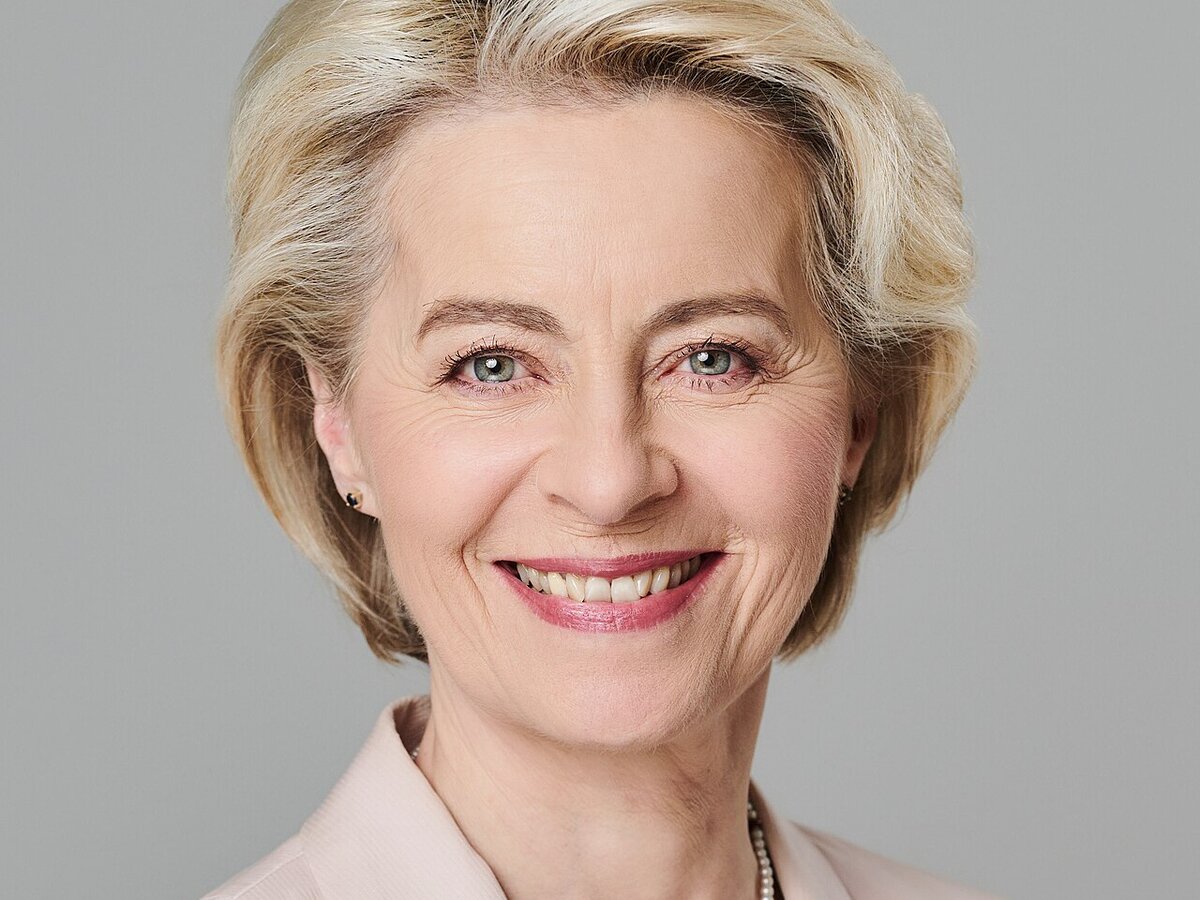
Ursula von der Leyen was the first woman to lead the European Commission, in 2019, and the first in Germany to run the defence ministry, in 2013. Re-elected by the European Parliament in July 2024, she is in her second five-year term at the head of the EU’s executive. In November 2026, she said Europe would take a close part in any peace negotiations between Russia and Ukraine.
Brussels, Hanover and London
She was born Ursula Albrecht on 8 October 1958 in Ixelles, Brussels, where her father, Ernst Albrecht, was a senior official at the European Commission. The family moved to Lower Saxony when she was 13; her father later became its minister-president. In 1978 she spent a year at the London School of Economics under a false name, Rose Ladson, because the Red Army Faction had threatened her family.
She first studied economics, then switched to medicine in Hanover. She qualified as a doctor, worked at a women’s clinic and earned her doctorate in 1991. With her husband, Heiko von der Leyen, also a doctor, she lived for several years in Stanford, California. They have seven children.
Fourteen years in Angela Merkel’s governments
A member of the Christian Democratic Union (CDU), she was appointed social affairs minister of Lower Saxony in 2003. In 2005 Angela Merkel made her federal minister for family affairs: she introduced the parental allowance (Elterngeld) and encouraged fathers to take leave, against part of her own camp. She moved to labour in 2009, then defence in December 2013, the first woman in that post in Germany.
The Commission
In July 2019 the European Council nominated her, though she had not been a lead candidate in the European elections. The European Parliament confirmed her with 383 votes, only nine more than she needed. She took office on 1 December 2019.
Her first term was dominated by the pandemic, with joint vaccine purchasing and the NextGenerationEU recovery plan financed by common borrowing, and then by Russia’s full-scale invasion of Ukraine. Her handling of vaccine contracts has drawn criticism: in May 2025 the EU General Court ruled that the Commission had been wrong to refuse a journalist access to her text messages with the head of Pfizer. In 2025 she survived two motions of censure in the European Parliament.
On 18 July 2024, MEPs re-elected her with 401 votes, a wider margin than in 2019.
Autumn 2026
On 16 September 2026 she gave her annual State of the Union address in Strasbourg. In November she attended the informal meeting of EU leaders in Dublin and, on 15 November, said Europe would “closely engage” in peace negotiations between Russia and Ukraine. Her second term runs until 2029.
See also our profiles of Christine Lagarde, president of the European Central Bank, and Giorgia Meloni.
© Photo: European People’s Party - CC BY 2.0 (cropped)