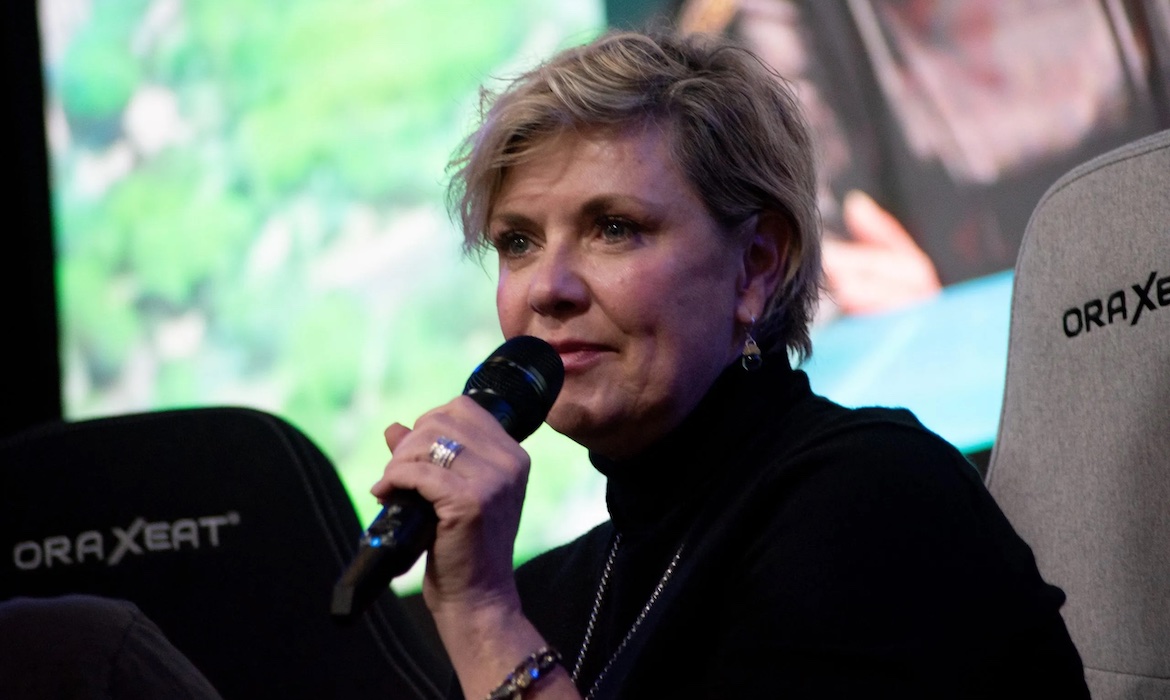
Recorded in February 2026, ahead of the Oscars, Chloé Zhao's conversation with Ben Mankiewicz opened the third season of the Talking Pictures podcast. Hamnet had eight nominations at the time. On 15 March Jessie Buckley won Best Actress for the film, while Zhao, who went on to sit on the Cannes jury chaired by Park Chan-wook in May, did not win. For most of the hour, she talks about what brought her to film in the first place.
Terminator 2 on Sundays in Beijing
Chloé Zhao did not think about becoming a filmmaker until her twenties. She wanted to tell stories, on a page or with her body, and she was bored in class. In Beijing, television showed one Western film a week, on Sundays: Terminator 2, True Lies, Ghost, Sister Act. 'Wow,' she remembers thinking, 'this must be what the other side of the world looks like.'
Later came Wong Kar-wai's Happy Together. A love story between two men did not surprise her, because the Japanese anime she grew up on was full of them. What mattered to her was seeing two actors she adored in the same film.
At 15 she left for Brighton College in England, able to write some English but hardly to speak it. Her first cinema trip in the West was a double bill of The Mummy and The Matrix. She followed all of the first and none of the second, though she thought Keanu Reeves was really cute.
Mr Feinstein of Los Angeles High School
At around 19 she chose Los Angeles, because she had seen it in the movies and thought it would feel like home. She was, she says, 'humbled by reality in the best way possible'. She lived alone in Koreatown, behind a Sizzler, and enrolled at Los Angeles High School.
That is where the story Ben Mankiewicz says he never saw coming takes place. Mr Feinstein, who taught government, was so struck by how little she knew that he kept her back every day to explain the world to her. More than a decade later she returned to the school to find him. Another teacher, Mr Moy, told her he was dying and gave her the hospital's number. Sitting on the steps outside, she called, told his wife she was 'that Chinese girl with a British accent', and was put through.
He remembered her. That had been his last year of teaching, he said, after 35 years, and he had lost some of his passion. A student who knew so little and wanted so badly to learn had brought it back. She told him she was going to make a film on a Lakota reservation and hoped to show it to him. He died before she could. Because of him she studied American politics at college. 'I would not be here today if this wasn't for him.'
A piece of fan fiction called The Rider
She has been writing fan fiction since she was 12 and considers that she has never stopped. To her it comes down to falling in love with a character and wanting to give that character another universe to live in. The Rider, with the young cowboy Brady Jandreau, was in her eyes a fan-fiction film.
Westerns came after that film and years in South Dakota: Red River, Jeremiah Johnson, My Darling Clementine, Unforgiven. The cowboys she met were nothing like the ones on screen, though. 'There's nothing stoic about them,' she says. 'They're deeply passionate and very emotional.'
Dancing on the set of Hamnet
On Hamnet, the company danced once or twice a week. All the dance takes, stitched together, ran to about 30 minutes and were screened at the wrap party. Zhao's reasoning is practical. Emotion is energy, and once actors have agreed to feel it, the production owes it to them, and to the crew, to help get it out of the body.
Hiring worked the same way, from production assistants to actors: resumes and status counted for nothing next to a willingness to be vulnerable and to hold other people's vulnerability. When a scene overwhelms her, she allows herself to cry in front of everyone, take five, and accept comfort from Paul Mescal, Jessie Buckley or the stills photographer. On this film she learned that strength in leadership comes from 'interdependence and relationships', as opposed to dominance and power.
The script kept its own calendar. Maggie O'Farrell, who wrote the novel and co-wrote the film, had produced a chronological first draft. After an intense time with Jessie Buckley in New York, Zhao asked to put Dracula on hold and took the train to Los Angeles: four days, one change in Chicago, no sleep. She reached Union Station with the second draft so exhausted that, waiting for her Uber, she thought about warning her producing partner she might faint.
Two Oscars and a garden
Where are her two Nomadland statuettes? One is in China with her father, who has thrown a great many parties in its name. The other is in storage, or possibly at her best friend's house. She is not sure. She spent years trying to cure herself of being nomadic before accepting it, and says she gets attached to people, not objects.
Mankiewicz ends by reminding her of a 2018 remark about being a pessimist. Joy that comes from outside, she replies, will never match dancing in the Globe Theatre. The other side of that suits her well enough. Hard things in her career have hurt, she says, without destroying anything for good. 'It did not kill my garden and my forest. It's going to grow back.'
© Video: HBO Max / Turner Classic Movies