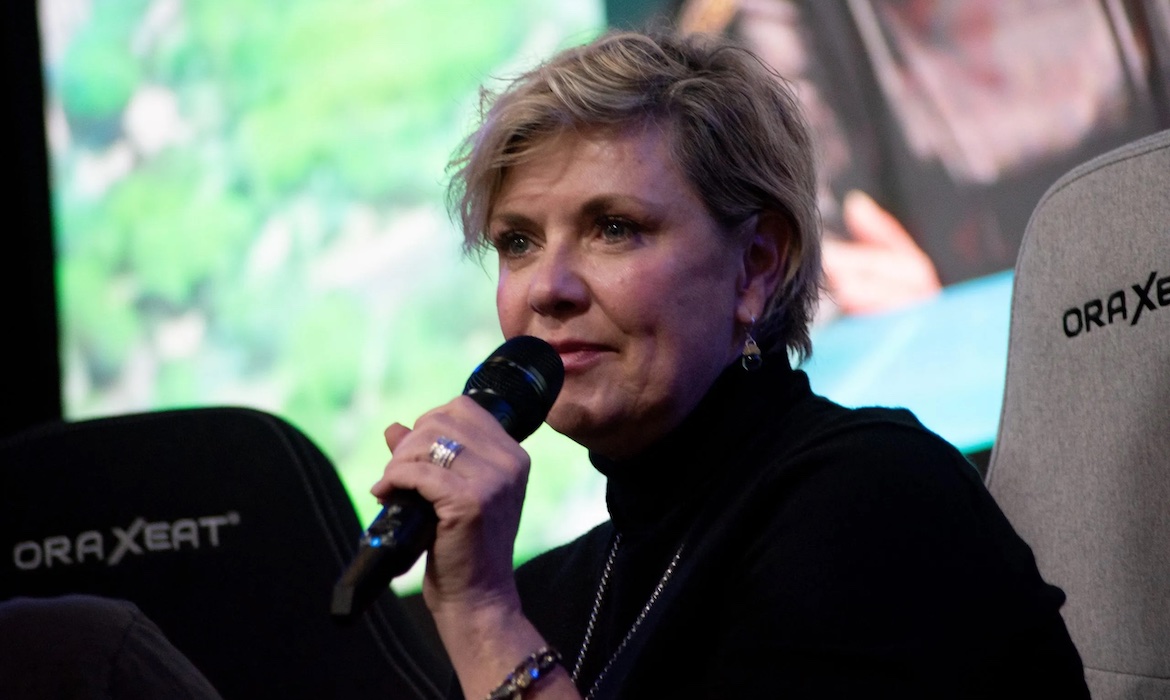
Preparing to interview Susan Sarandon, Ben Mankiewicz set out to pick eight to 12 films. His list had reached 23 when he gave up, and he had only got to 2009. Published in June 2026 on the Talking Pictures podcast, the episode follows a busy spell: an International Goya in Barcelona on 28 February, and The Accompanist, Zach Woods's first feature, shown at the Tribeca Festival, in which she plays an old woman who takes in a nine-year-old girl.
The eldest of nine
Sarandon did not go to the movies as a child. As the eldest of nine, she stayed home babysitting. Her mother grew up in institutions, and her father was on his own from the age of 16. He sang with big bands, then worked as a stage manager and ended up a vice-president at Ogilvy & Mather.
At Catholic school, in the third grade, she was taught that only a marriage in the Church really counts. She put her hand up and asked how Joseph and Mary could be married if Jesus came along later. She was sent to stand in the hallway, told she had 'an overabundance of original sin'. The Church, as she tells it, was separating from her before she knew to separate from it.
The name comes from Chris Sarandon, whom she married before her senior year at the Catholic University of America. She never planned to act, and was told her voice was wrong for the stage. She read with him at an audition, the agent Jane Oliver invited them back, and John G. Avildsen saw her for Joe, released in 1970. He asked her to do an improv. She asked him what that was.
Her method then still holds: know the lines, understand the scene and listen to the other person. 'I'm a very good listener.' She has always seen herself as a character actor, and credits that for her longevity, since few of the ingénues she started with became leading ladies. Playing people unlike yourself, she says, is 'enforced compassion'.
She won her Oscar on her fifth nomination, for Dead Man Walking, directed by Tim Robbins, her partner at the time. Laurence Fishburne, sitting behind her, had warned that if she didn't win this time, they would burn the place down. She remembers nothing of her speech.
Pneumonia, fires and a cello
The films that look like fun were not always fun to make. The Rocky Horror Picture Show was shot in an English winter, in a studio with no heating. She caught pneumonia. The space heater brought in for her caught fire, and so did her trailer, along with a Calvin Klein raincoat that had been her big purchase. She took the job, for no money to speak of, precisely because she had always been told she couldn't sing. 'And I still can't sing.'
On The Witches of Eastwick, she arrived in California after fittings for Alex and learned the part had gone to Cher. She would now play a barely written cellist, with two weeks to learn the instrument. She was told that if she left, she wouldn't work. Her daughter was 18 months old and she was all but a single parent, so she stayed. A three-month shoot became six because nobody could settle on an ending.
Too old for Bull Durham
For Bull Durham, the studio hesitated. Mankiewicz notes that Mike Medavoy thought she was too old, which she says is news to her. She flew in from Italy at her own expense, read the whole script with Kevin Costner, then called in at the studio in a tight red and white striped dress. 'Most of these banker minds don't have much imagination.' She loved the part because Annie holds her own, and because, for once in a sports film, the woman does not ask the man to give up his dream. She credits Costner with standing up for the film, for Ron Shelton, for Tim Robbins and for her.
Who fixes it and who blames
The shoot of Pretty Baby (1978) left her with memories of an all-male American crew from racing pictures and B movies, who had no idea who Louis Malle or Sven Nykvist were and kept sneaking lights back in. Having women on crews has changed the mood, she says, though she does not believe being a woman makes anyone good at a job. 'When there's a problem, women go to fix it. Guys go to figure out whose fault it is.' Mankiewicz's conclusion, that progress means giving women as much opportunity as men to be bad at their jobs, gets a firm 'Absolutely'.
Her wider argument follows from this: every film either challenges the status quo or reinforces it. Her example is The Nutty Professor, which gets audiences rooting for the fat guy to get the girl. So she got into the habit of asking why she was taking a job, and of explaining it to her children, whom she took everywhere.
The kiss in Thelma & Louise
Thelma & Louise turns 35 this year. Before signing, she asked Ridley Scott one thing: would the ending be tested and turned into Club Med? He told her they would go over, though he was not yet sure Louise wouldn't push Thelma out of the car. The scene came at the very end of the shoot, at magic hour, with time for one take. A lot of dialogue was cut, and she said she would like to kiss Geena Davis. Scott and Davis were both fine with it. The freeze frame she puts down to him: instead of a crumpled car, the audience sees a triumphant act. The car itself was emptied, its engine removed, and slingshotted off the cliff. 'I don't want to ruin your day, but we were not in it.'
She is now putting together a tiny film, for which she found the money herself, and hopes to shoot it in black and white.
© Video: HBO Max / Turner Classic Movies