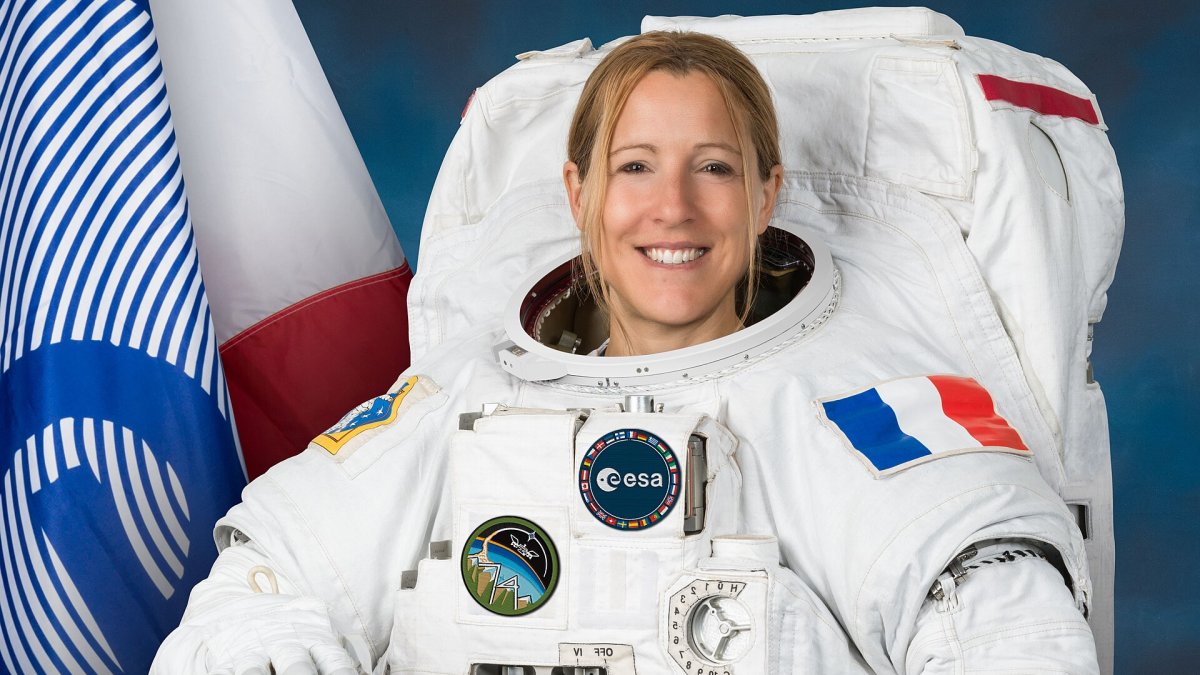
At 17:34 Paris time on 8 October 2026, a Crew Dragon capsule splashed down in the Pacific off the coast of California. Inside was Sophie Adenot, coming home after 235 days aboard the International Space Station. No European astronaut, man or woman, had ever stayed in orbit that long in one go.
She was not alone in the capsule. Strapped in beside her were her three Crew-12 crewmates: mission commander Jessica Meir and Jack Hathaway of the United States, and Andrei Fedyaev of Russia. The recovery ship MV Shannon lifted the capsule on board, and the crew were flown by helicopter to dry land. “We are very happy to be back on Earth after an incredible mission,” Meir said. The return, first planned for 5 October, had been pushed back twice.
Eight months, 400 kilometres up
Adenot launched from Cape Canaveral on 13 February 2026 and reached the ISS the next day. She had chosen the mission name herself: Epsilon. For almost eight months, about 400 kilometres above our heads, she worked through scientific experiments and the maintenance jobs that keep the station running.
The high point came late. In the space of two weeks she made three spacewalks, the first ever by a French woman. She spent 19 hours and 42 minutes outside in all, more than any other European woman. Asked about it during a press conference from orbit, she did not hesitate: “Without any doubt, for me, the spacewalks will remain the highlight of this mission.”
Before leaving, in a video posted on Instagram, she still admitted to “a touch of nostalgia” at the thought of leaving the orbiting laboratory. Eight months is long enough to get attached to a place, even that one.
A pilot who failed the first time
Sophie Adenot was born on 5 July 1982 in Cosne-Cours-sur-Loire, in central France. She trained as an engineer at ISAE-SUPAERO in Toulouse, took a master’s degree in human factors engineering at MIT in 2004, and then spent a year at Airbus Helicopters in Marignane designing cockpits.
In 2005 she joined the French Air Force to fly helicopters. She spent four years with a search and rescue squadron in Cazaux, then five years as an aircraft captain in the squadron that flies government officials, based at Villacoublay. In 2018 she graduated from the Empire Test Pilots’ School in the UK and became France’s first female helicopter test pilot. She has logged more than 3,000 flying hours on some twenty aircraft types.
Her first attempt to become an astronaut, in 2008, did not work out. She has since said that she lacked self-confidence at the time. She tried again in 2022, and on 23 November that year the European Space Agency picked her from more than 22,500 applicants. She earned her astronaut certification in April 2024 and, a month later, was named the first of her class to fly.
Thirty years after Claudie Haigneré
Before her, only one French woman had been to space: Claudie Haigneré, in 1996 and again in 2001. It took thirty years for a second one to follow. That is a long time. Long enough for girls who dreamed of the stars in the 1990s to grow up, pick another career and have children of their own. So this homecoming matters a little more than most.
Learning gravity again
For astronauts, the hard part sometimes starts on landing. After eight months of weightlessness, muscles and bones have weakened, and standing up without thinking about it has to be relearned. After her first medical checks in Houston, Adenot flew back to Europe aboard a French Air and Space Force A330 MRTT Phénix from Istres air base. She is now following a recovery programme of about three weeks at ESA’s astronaut centre in Cologne.
Then will come the talks, the school visits and the questions people will ask her everywhere. For the girls listening, the most useful part of her story may not be space at all. It is that she failed once, and tried again.
© Photo: NASA Johnson Space Center / Helen Arase Vargas (NASA-JSC) - public domain