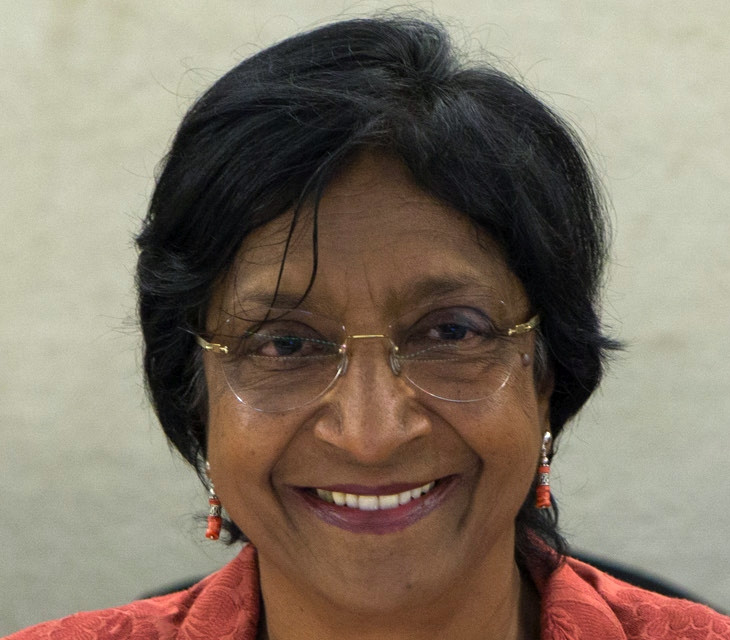
On 9 October 2026 the Norwegian Nobel Committee awarded the Nobel Peace Prize to Navanethem “Navi” Pillay, an 85-year-old South African jurist, “for her efforts to promote peace and international law”. She is the first South African woman to receive it. When she was told, her first thought was that it must be a joke.
She was at the Palace of Justice in Nuremberg that day, where the Nazi leaders were tried after the war. It is hard to think of a more fitting place to hear the news. She dedicated the award “to all of the survivors of international crimes”.
The committee was blunt about its reasons: international law “is no longer just a supplement to peace and security. It is an absolute necessity.” Its chair, Jørgen Watne Frydnes, added that the system was “under tremendous pressure” and that its institutions were “under attack”.
Granddaughter of indentured workers
Navanethem Naidoo was born on 23 September 1941 in Durban, in what was then the province of Natal, into a family of Indian Tamil origin. Her grandparents had come from India as indentured labourers, workers bound for years to the plantations of the British Empire.
She studied law at the University of Natal and opened her own practice in 1967, in the middle of apartheid. No non-white woman in the province had done so before her. She defended anti-apartheid activists, and in 1973 she won the right for Robben Island prisoners, Nelson Mandela among them, to see their lawyers.
She then went to Harvard, where she took a master’s degree and, in 1988, a doctorate in law, the first South African to do so. In 1992 she co-founded Equality Now, an international women’s rights organisation. During the transition to democracy she pushed for an equality clause in the new Constitution, and in 1995 she became the first non-white woman appointed to South Africa’s High Court.
Arusha, 1998
She did not stay there long. That same year the United Nations called her to the International Criminal Tribunal for Rwanda, set up after the genocide against the Tutsi. She served there until 2003, four of those years as its president.
This is where she was part of the ruling that made her name. In 1998, in the case of Jean-Paul Akayesu, former mayor of the Taba commune, the tribunal found for the first time that rape and sexual violence can constitute genocide and crimes against humanity. Until then, rape in war had too often been treated as an unfortunate fact of conflict. After Akayesu it became a crime that could be tried at the highest level. The Nobel Committee cited this work among the reasons for its choice. For a site about women, it is probably the most important line in her story.
From The Hague to Geneva
She went on to sit on the Appeals Chamber of the International Criminal Court from 2003 to 2008, then served as UN High Commissioner for Human Rights from 2008 to 2014. Since 2019 she has also been an ad hoc judge at the International Court of Justice in the case brought by The Gambia against Myanmar, which is accused of genocide against the Rohingya.
A divisive award
Until November 2025 she chaired the UN’s Independent International Commission of Inquiry on the Occupied Palestinian Territory, set up in 2021. In June 2024 the commission found that both Hamas and Israel had committed war crimes. In September 2025 it concluded that Israel had committed genocide in Gaza. Israel called the report “scandalous”.
Reactions to the prize split along the same line. UN Secretary-General António Guterres called it a tribute to everyone working to uphold international law, human rights and peace. South African President Cyril Ramaphosa praised it as a “profound tribute” to her courage and integrity. Israel’s Foreign Ministry condemned “the grotesque weaponization of an award to legitimize anti-Israel hatred and prejudice”, and Benjamin Netanyahu said the committee had “lost its moral compass”. In Washington, Donald Trump said the committee had “demeaned” the prize, while Secretary of State Marco Rubio announced further sanctions against the International Criminal Court.
Pillay answered with a joke. “If you clap a little bit louder I may share this prize with Trump,” she told the audience. Then, more seriously: “We are living through an era when international law and human rights are under significant political attack.”
Oslo, 10 December
The prize, worth 12 million Swedish kronor, will be presented in Oslo on 10 December, the anniversary of Alfred Nobel’s death. She is the fifth South African laureate, after Albert Lutuli, Desmond Tutu, F. W. de Klerk and Nelson Mandela.
At 85 she still sits in The Hague. The granddaughter of plantation workers from Natal has spent her life defending a simple idea: the worst crimes must have judges, and the women who survived them must be heard.
© Photo: US Mission Geneva - public domain